Jump15of 100 · 630 M km from Earth
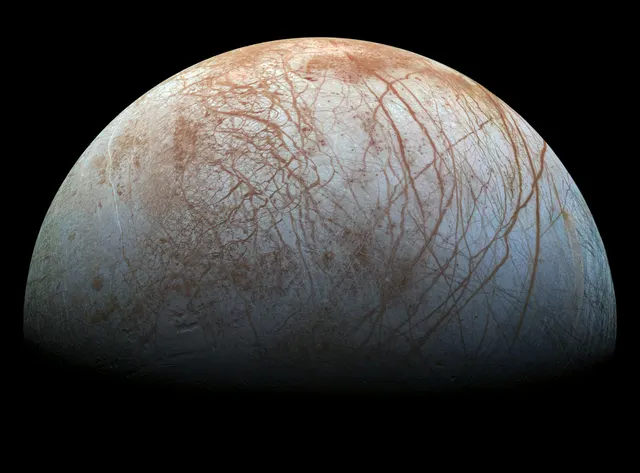
Europa: twice Earth’s water, under the ice
Europa, the moon of Jupiter with an ocean under the ice that may hold twice Earth’s water. Facts with their sources, and Europa Clipper.
Curious facts
-
Twice the water of Earth
Under its ice shell lies a salty ocean that, according to NASA, holds twice as much water as all of Earth’s oceans together. It is one of the best places to look for conditions suitable for life. 1
-
About 29 km of ice on top
The Juno spacecraft measured the ice in the region it flew over on 29 September 2022: about 29 km thick on average. It is an estimate: it could be thicker, or a little thinner if the ice holds salt. 2
-
Europa Clipper arrives in 2030
The Europa Clipper probe left for it in October 2024. It will start orbiting Jupiter on 11 April 2030 and fly past Europa 49 times. The plan is to end the mission by crashing it into Ganymede in September 2034. 13
Videos
My shorts about Europa, in Spanish.
-
 La luna que escupe agua al espacio
With AI-made illustrations, labelled on screen
No video loads until you tap one. Then it comes from YouTube (youtube-nocookie.com), which receives your IP address. More in the website privacy policy.
Europa in Orbit
In the game, Europa is jump 15 of the route, 630 M km from Earth. Its logbook card says:
Logbook · Jump 15
Its ice may hide twice the water of Earth's oceans
Two steps with the Google account you use on Play: join the group, then download the test. Google Play can take a while, sometimes more than an hour, before it lets you download it; if you see “Item not found”, wait and try again.
Sources
- NASA, Europa. science.nasa.gov/jupiter/moons/europa
- NASA JPL, 2025. jpl.nasa.gov/news/nasas-juno-measures-thickness-of-europas-ice-shell
- NASA JPL, Europa Clipper. jpl.nasa.gov/press-kits/europa-clipper/mission
Checked between 8 and 11 October 2026.
Image: NASA/JPL-Caltech/SETI Institute · original