Jump79of 100 · 64.5 light years from Earth
HD 189733 b: it may rain glass, sideways
HD 189733 b is a blue planet where it may rain glass sideways, with a gas that smells of rotten eggs. Facts with their sources, and videos.
Curious facts
-
Glass rain, sideways
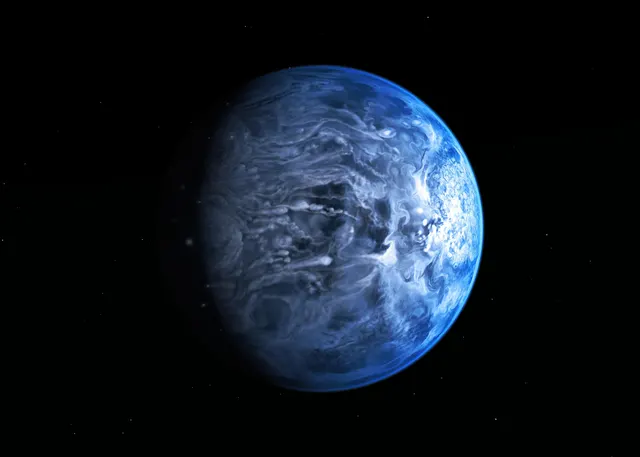
This gas giant, 63 light years away, is cobalt blue because of clouds laced with silicate particles. Those particles could form drops of glass that, in winds of up to about 8,700 km/h, would fall sideways. Caveat: that is what NASA and ESA propose from the colour Hubble measured; nobody has seen the rain, and the wind figure varies between sources. 12
-
A gas that smells of rotten eggs
In 2024 the James Webb telescope detected traces of hydrogen sulfide, the gas that smells of rotten eggs. It was the first time it had been found in the atmosphere of a planet around another star. Nobody has smelled it, of course: they are traces. 34
-
About 900 °C
Its temperature is around 900 °C. 4
Videos
My shorts about HD 189733 b, in Spanish.
-
 Todo esto existe de verdad
-
Un planeta donde llueve cristal… de lado
With AI-made illustrations, labelled on screen
No video loads until you tap one. Then it comes from YouTube (youtube-nocookie.com), which receives your IP address. More in the website privacy policy.
HD 189733 b in Orbit
In the game, HD 189733 b is jump 79 of the route, 64.5 light years from Earth. Its logbook card says:
Logbook · Jump 79
It rains glass sideways in 8,700 km/h winds
Two steps with the Google account you use on Play: join the group, then download the test. Google Play can take a while, sometimes more than an hour, before it lets you download it; if you see “Item not found”, wait and try again.
Sources
- NASA. nasa.gov/image-article/rains-of-terror-exoplanet-hd-189733b
- ESA/Hubble. esahubble.org/news/heic1312
- Fu et al., Nature (2024). doi.org/10.1038/s41586-024-07760-y
- University of Maryland, 2024. cmns.umd.edu/news-events/news/nearby-exoplanet-reeks-rotten-eggs-and-thats-good-thing
Checked between 8 and 11 October 2026.
Illustration, not a photo Image: NASA, ESA, M. Kornmesser · original