Jump12of 100 · 629 M km from Earth
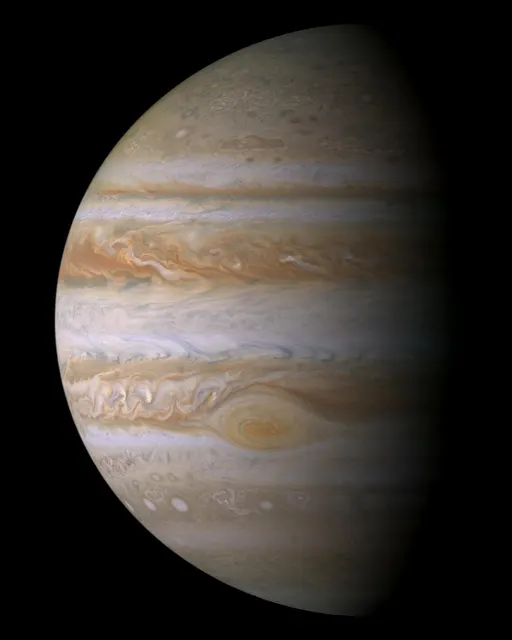
Jupiter: a storm bigger than Earth
Jupiter has had a storm bigger than Earth for over 300 years, and its gravity keeps Io’s volcanoes alive. Facts with their sources.
Curious facts
-
A storm bigger than Earth
The Great Red Spot is a storm bigger than Earth that has been observed for more than 300 years. The winds in Jupiter’s bands reach about 539 km/h at the equator. 1
-
Its gravity lights volcanoes
Jupiter stretches and squeezes its moon Io on every orbit, and that kneading melts part of its interior: JPL estimates Io has about 400 volcanoes. 2
-
Three moons in step
For every orbit of Ganymede, Europa makes two and Io four. Those synchronised tugs keep Io’s orbit oval. 3
-
The biggest moon is its own
Ganymede, one of its moons, is the largest in the Solar System: bigger than the planet Mercury, and the only one with its own magnetic field. 4
Videos
My shorts about Jupiter, in Spanish.
-
 La luna que escupe agua al espacio
With AI-made illustrations, labelled on screen
No video loads until you tap one. Then it comes from YouTube (youtube-nocookie.com), which receives your IP address. More in the website privacy policy.
Jupiter in Orbit
In the game, Jupiter is jump 12 of the route, 629 M km from Earth. Its logbook card says:
Logbook · Jump 12
Its Great Red Spot is a storm bigger than Earth
Two steps with the Google account you use on Play: join the group, then download the test. Google Play can take a while, sometimes more than an hour, before it lets you download it; if you see “Item not found”, wait and try again.
Sources
- NASA, Jupiter Facts. science.nasa.gov/jupiter/jupiter-facts
- NASA JPL, 2024. jpl.nasa.gov/news/nasas-juno-mission-uncovers-heart-of-jovian-moons-volcanic-rage
- NASA, Io: Facts. science.nasa.gov/jupiter/jupiter-moons/io/facts
- NASA, Ganymede. science.nasa.gov/jupiter/jupiter-moons/ganymede
Checked between 8 and 11 October 2026.
Image: NASA/JPL/Space Science Institute · original