Jump19of 100 · 1,280 M km from Earth
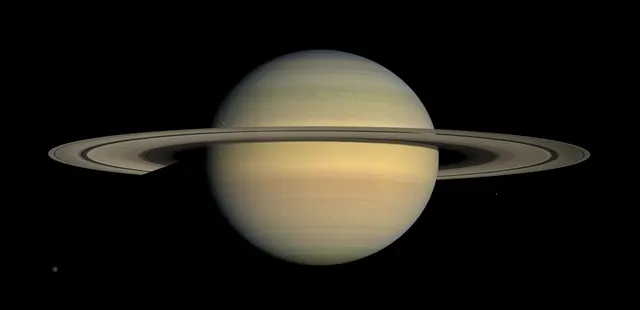
Saturn: it would float in water
Saturn is less dense than water and its rings are raining down onto it. Curious facts with their sources and my videos about Saturn.
Curious facts
-
It would float in water
It is the only planet in the Solar System with an average density lower than water. Given a big enough bathtub, it would float. It is made mostly of hydrogen and helium, like the Sun. 1
-
Its rings are raining down
The rings are falling into the planet as a rain of ice particles, pulled by gravity and the magnetic field. According to a 2018 NASA study, every half hour they lose enough water to fill an Olympic swimming pool. 2
-
It may lose its rings
At that rate, adding what falls at the equator, the rings could be gone in less than 100 million years, while Saturn is over 4 billion years old. It is an estimate. The study’s author put it this way: we are lucky to be around to see them. 2
Videos
My shorts about Saturn, in Spanish.
-
 Saturno flotaría en el agua
With AI-made illustrations, labelled on screen
-
 La luna que escupe agua al espacio
With AI-made illustrations, labelled on screen
No video loads until you tap one. Then it comes from YouTube (youtube-nocookie.com), which receives your IP address. More in the website privacy policy.
Saturn in Orbit
In the game, Saturn is jump 19 of the route, 1,280 M km from Earth. Its logbook card says:
Logbook · Jump 19
It is less dense than water
Two steps with the Google account you use on Play: join the group, then download the test. Google Play can take a while, sometimes more than an hour, before it lets you download it; if you see “Item not found”, wait and try again.
Sources
- NASA, Saturn Facts. science.nasa.gov/saturn/facts
- NASA, 2018. nasa.gov/news-release/nasa-research-reveals-saturn-is-losing-its-rings-at-worst-case-scenario-rate
Checked between 8 and 11 October 2026.
Image: NASA/JPL/Space Science Institute · original