World Space Week 2026: 25 real facts about planets, moons and exoplanets
Daniel Rodríguez Cabrera ·
World Space Week runs every year from 4 to 10 October. The UN General Assembly declared it in December 1999, in resolution 54/68, and the dates mark two anniversaries: the launch of Sputnik 1 on 4 October 1957 and the entry into force of the Outer Space Treaty on 10 October 1967 (UN press release). The 2026 theme, according to the association that coordinates it, is “Rocket Revolution”: reusable rockets and the many new teams now launching things into space.
My game, Orbit, travels through 101 real places, from Earth to Sagittarius A*, and each one carries a fact on its atlas card. For this week I picked 25 of them and checked each against NASA, ESA, JPL and ESO. In the game they fit in one line; here they come with context and a source. Some needed a caveat, and I explain it where it applies.
Planets of the Solar System
-
Venus: its day is longer than its year
Venus takes 243 Earth days to spin once and only 225 to go around the Sun. It also spins the opposite way to Earth, so there the Sun would rise in the west and set in the east.
Source: NASA
-
Mercury: 430 °C by day, −180 °C at night
It is so close to the Sun that its surface reaches 430 °C by day. With no atmosphere to hold that heat, it drops to −180 °C at night. Even so, it is not the hottest planet: Venus is, because of its thick atmosphere.
Source: NASA
-
Mars: the largest volcano in the Solar System
Mars has Olympus Mons, the largest known volcano in the Solar System. It is a gently sloping shield volcano: its base covers an area the size of the state of Arizona and its summit rises far above Everest’s 8,848 m.
Source: NASA
-
Jupiter: a storm bigger than Earth
The Great Red Spot is a storm bigger than Earth that has been observed for more than 300 years. The winds in Jupiter’s bands reach about 539 km/h at the equator.
Source: NASA
-
Saturn: it would float in water
It is the only planet in the Solar System with an average density lower than water. Given a big enough bathtub, it would float. It is made mostly of hydrogen and helium, like the Sun.
Source: NASA
-
Uranus: it spins on its side
Its axis is tilted 97.77 degrees, so it rolls around the Sun almost on its side. This may be the mark of a collision with an Earth-sized object long ago. It also gives Uranus the most extreme seasons: each pole spends a 21-year winter in the dark.
Source: NASA
-
Neptune: the fastest winds in the Solar System
On Neptune the wind blows at more than 2,000 km/h. That is three times stronger than Jupiter’s winds and nine times stronger than the worst storms on Earth.
Source: NASA
-
Pluto: a nitrogen glacier in its heart
The bright heart-shaped region New Horizons photographed in 2015 is called Tombaugh Regio. The glacier is only its left half, Sputnik Planitia: a plain of frozen nitrogen with no craters, a sign that it is young. In August 2026 NASA published evidence of liquid nitrogen rising through cracks along its northern edge.
Source: NASA, 2026, NASA
Moons
-
The Moon drifts 3.8 cm farther away every year
We know because lasers measure the distance to the mirrors the Apollo missions left there from 1969 onwards. Tides are the cause: the bulge the Moon raises in the oceans pulls it forward and lifts it into a slightly higher orbit, while slowing Earth’s spin a little.
Source: NASA JPL
-
Phobos: falling towards Mars 1.8 m every century
Mars’s largest moon is getting closer to the planet by about 1.8 metres every hundred years. At that rate, in about 50 million years it will either crash into Mars or break up into a ring.
Source: NASA
-
Io: the most volcanically active world
It is the most volcanically active place in the Solar System: hundreds of volcanoes, some with lava fountains dozens of kilometres high. Jupiter’s gravity and the pulls of two neighbouring moons stretch and squeeze it on every orbit, and that heats it from inside.
Source: NASA
-
Europa: twice the water of Earth
Under its ice shell lies a salty ocean that, according to NASA, holds twice as much water as all of Earth’s oceans together. It is one of the best places to look for conditions suitable for life, which is why the Europa Clipper probe left for it in October 2024.
Source: NASA
-
Ganymede: a moon bigger than Mercury
It is the largest moon in the Solar System, bigger than the planet Mercury and than Pluto. It is also the only moon with its own magnetic field, and there is strong evidence of a salty ocean under its surface.
Source: NASA
-
Enceladus: water geysers from the south pole
Cracks near its south pole shoot jets of water vapour and ice grains out into space. The Cassini probe studied them for years, and NASA explains that they are fed by a global ocean under the ice, which there may be only 1 to 5 km thick.
Source: NASA
-
Titan: lakes and seas of methane
It is the only place besides Earth known to have liquids on its surface. It has clouds, rain, rivers, lakes and seas, but not of water: they are hydrocarbons such as methane and ethane.
Source: NASA
-
Triton: the moon that goes backwards
It is the only large moon in the Solar System that orbits its planet in the opposite direction to the planet’s spin. Most likely it was a Kuiper Belt object that Neptune captured with its gravity millions of years ago.
Source: NASA
Exoplanets
-
51 Pegasi b: the first around a Sun-like star
In 1995 Michel Mayor and Didier Queloz found the first planet orbiting a star like the Sun. It is a gas giant that circles its star in 4.2 days, and the discovery earned them the 2019 Nobel Prize in Physics.
Source: NASA, Nobel Prize
-
Proxima b: the nearest known exoplanet
It lies about 4.2 light-years away and orbits Proxima Centauri inside its habitable zone, the band where liquid water could exist. Its mass is close to Earth’s and its year lasts 11.2 days. Being in that band does not make it habitable: its star is a red dwarf with strong flares.
-
TRAPPIST-1e: one of seven Earth-sized worlds
TRAPPIST-1, a cool star about 40 light-years away, has seven Earth-sized planets, the largest such group known around a single star. Three of them, e, f and g, sit in the habitable zone.
Source: NASA JPL
-
HD 189733 b: glass rain, sideways
This gas giant, 63 light-years away, is cobalt blue because of clouds laced with silicate particles. Those particles could form drops of glass that, in winds of up to about 8,700 km/h, would fall sideways. Caveat: that is what NASA and ESA propose from the colour Hubble measured; nobody has seen the rain, and the wind figure varies between sources.
Source: NASA, ESA/Hubble
-
KELT-9b: hotter than most stars
Its dayside tops 4,600 kelvin, about 4,300 °C. It is so hot that the heat tears apart the molecules in its atmosphere, and it goes around its star in just 1.5 days.
-
Kepler-16b: two suns, like Tatooine
In 2011 it became the first confirmed planet orbiting two stars at once. It is not a desert like the one in Star Wars but a cold gas world, yet from there you would see two sunsets.
Source: NASA, CfA Harvard
-
K2-18 b: methane confirmed, life not
In 2023 the James Webb Space Telescope found methane and carbon dioxide on this planet, 8.6 times as massive as Earth and 120 light-years away. The same team mentioned a possible signal of dimethyl sulfide (DMS), a molecule that on Earth only living things make. Caveat: independent analyses in 2025 find no sufficient evidence for DMS, and one does not clearly see the CO2 either. The methane holds up.
Source: NASA, 2023, Luque et al., 2025
Black holes
-
Gaia BH1: the nearest known black hole
It lies about 1,560 light-years away, in the constellation Ophiuchus, and has about 9.6 times the mass of the Sun. It cannot be seen: it was found in 2022 from the wobble of a Sun-like star orbiting it, measured by ESA’s Gaia satellite. It is less than half as far away as the previous record holder.
-
Sagittarius A*: the black hole at the centre of the galaxy
It has about 4 million times the mass of the Sun and lies about 27,000 light-years away. On 12 May 2022 the Event Horizon Telescope, which links radio telescopes across the planet, released its first image: a dark shadow inside a ring of bright gas.
Source: ESO / EHT
Frequently asked questions
When is World Space Week?
From 4 to 10 October, every year. The UN declared it in 1999 to mark the launch of Sputnik 1 (4 October 1957) and the entry into force of the Outer Space Treaty (10 October 1967). The 2026 theme is “Rocket Revolution”.
What is the nearest exoplanet to Earth?
Proxima b, about 4.2 light-years away. It orbits Proxima Centauri, the nearest star to the Sun, inside its habitable zone.
What is the nearest black hole to Earth?
Gaia BH1, about 1,560 light-years away in Ophiuchus. It was discovered in 2022 with data from ESA’s Gaia satellite.
Is there life on K2-18 b?
There is no evidence. Webb saw methane and carbon dioxide in 2023; the possible dimethyl sulfide (DMS) signal has not been confirmed and several 2025 analyses do not find it.
From Earth to Sagittarius A*, in Orbit
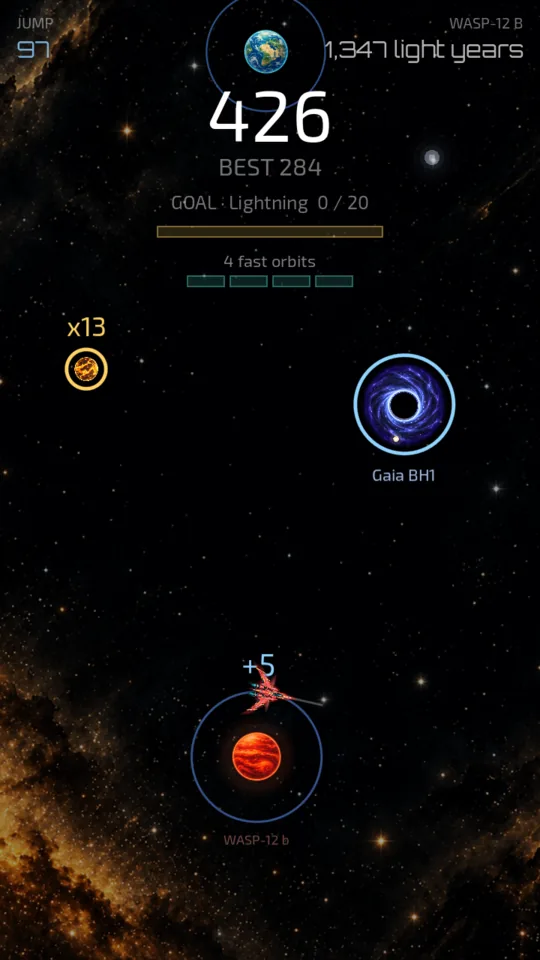
All these places appear in Orbit, a one-tap game for Android that I make on my own. You orbit a planet, tap and shoot off to the next: 101 real places, from Earth to Sagittarius A*, and each has its own card in the logbook’s atlas.
It is in closed testing on Google Play. To try it, join the tester group with the Google account you use on Play, then install it from the test link. More on the Orbit page.
Two steps with the Google account you use on Play: join the group, then download the test. Google Play can take a while, sometimes more than an hour, before it lets you download it; if you see “Item not found”, wait and try again.