Jump4of 100 · 78 M km from Earth
Phobos: the moon falling onto Mars
Phobos, the largest moon of Mars, falls 1.8 m closer every century and rises in the west twice a day. Facts with their sources.
Curious facts
-
Falling 1.8 m every century
Mars’s largest moon is getting closer to the planet by about 1.8 metres every hundred years. At that rate, in about 50 million years it will either crash into Mars or break up into a ring. 1
-
It rises in the west, twice a day
It goes around Mars in 7 hours and 39 minutes, faster than Mars itself spins. So, seen from the ground, it rises in the west and sets in the east, and it does so twice every Martian day. 23
-
It already has stretch marks
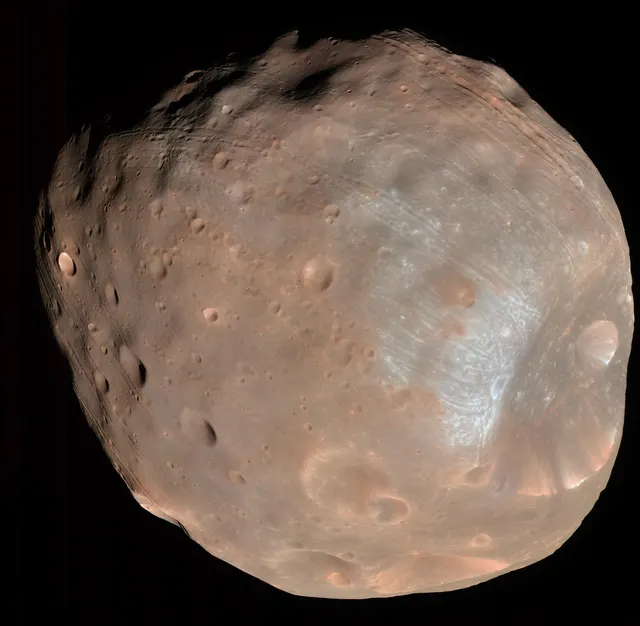
The long grooves across it may be the first sign that Mars’s gravity is pulling it apart, like stretch marks. That is the explanation a team at NASA Goddard gave in 2015, based on a model. 4
-
Small, with a huge crater
It measures about 27 × 22 × 18 km, and its crater Stickney covers almost half of one face. 1
Phobos in Orbit
In the game, Phobos is jump 4 of the route, 78 M km from Earth. Its logbook card says:
Logbook · Jump 4
Falls toward Mars 1.8 m every century
Two steps with the Google account you use on Play: join the group, then download the test. Google Play can take a while, sometimes more than an hour, before it lets you download it; if you see “Item not found”, wait and try again.
Sources
- NASA, Phobos. science.nasa.gov/mars/moons/phobos
- NASA Photojournal, PIA06339. science.nasa.gov/photojournal/two-moons-and-the-pleiades-from-mars
- NASA APOD, 22 March 2024. science.nasa.gov/image-article/apod-2024-march-22-phobos-moon-over-mars
- NASA, 2015. nasa.gov/solar-system/mars-moon-phobos-is-slowly-falling-apart
Checked between 8 and 11 October 2026.
Image: NASA/JPL-Caltech/University of Arizona · original