Jump37of 100 · 4,370 M km from Earth
Triton: the moon that goes backwards
Triton, a moon of Neptune, orbits backwards, has geysers at −235 °C and may one day break up near Neptune. Facts with their sources.
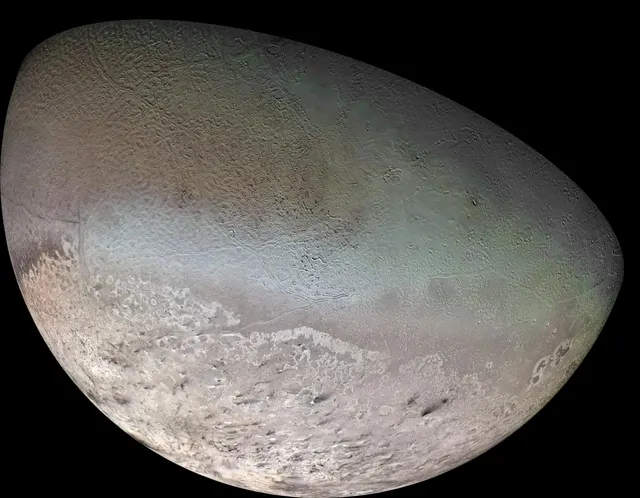
Curious facts
-
It goes backwards
It is the only large moon in the Solar System that orbits its planet in the opposite direction to the planet’s spin. Most likely it was a Kuiper Belt object that Neptune captured with its gravity millions of years ago. 1
-
Geysers at −235 °C
It is 2,700 km across and its surface sits at −235 °C. Even so, in 1989 Voyager 2 saw active geysers: columns of dark material about 8 km high, with clouds drifting downwind for more than 100 km. 12
-
It is closing in on Neptune
Because it orbits backwards, tides slow it down and bring it slowly closer to Neptune. According to a 1989 model, in about 3.6 billion years it would get so close that the planet’s gravity would break it apart, possibly into a ring. 3
Triton in Orbit
In the game, Triton is jump 37 of the route, 4,370 M km from Earth. Its logbook card says:
Logbook · Jump 37
Orbits backwards; Neptune probably captured it
Two steps with the Google account you use on Play: join the group, then download the test. Google Play can take a while, sometimes more than an hour, before it lets you download it; if you see “Item not found”, wait and try again.
Sources
- NASA, Triton. science.nasa.gov/neptune/moons/triton
- Soderblom et al., Science (1990). pubs.usgs.gov/publication/70015940
- Chyba, Jankowski and Nicholson, A&A 219 (1989). ntrs.nasa.gov/citations/19890064536
Checked between 8 and 11 October 2026.
Image: NASA/JPL/USGS · original